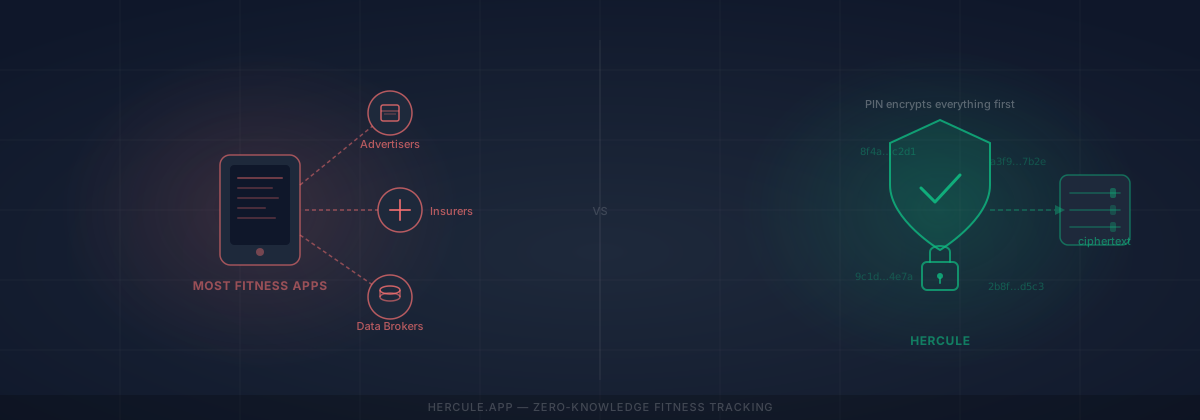
When you log your morning run, track your macros, or record your sleep, you're generating a precise, timestamped portrait of your physical life. Most fitness apps treat that portrait as inventory. You're not the customer — you're the product.
This isn't a conspiracy theory. It's a business model that most fitness apps openly describe in their privacy policies, buried under enough legalese that almost no one reads it. This article explains what's actually happening, why it matters, and what a genuinely private alternative looks like.
The hidden cost of "free"
Building and maintaining a fitness app — servers, engineers, support, updates — costs real money. When an app charges nothing, the business has to generate revenue another way. The most common answer: your data.
The data economy around health and fitness has grown substantially. Health data is considered among the most valuable categories of personal data for a simple reason: it's highly personal, surprisingly predictive, and impossible to change. You can get a new credit card number. You can't get a new body.
Worth noting: Most fitness apps are not covered by HIPAA. That law applies to healthcare providers and their business associates — not consumer apps. Your fitness app can legally sell what your doctor legally cannot.
What fitness apps actually collect
The scope goes far beyond workout logs. Depending on the app, data collection includes:
- Workout data — exercises, sets, reps, weight, duration, frequency, improvement over time
- Nutrition data — calories, macronutrients, meal timing, dietary restrictions, foods you eat regularly
- Body data — weight, body fat percentage, BMI, measurements, menstrual cycle tracking
- Location data — GPS routes from runs and rides, your home and work neighborhoods, daily movement patterns
- Sleep data — duration, quality, patterns (if the app connects to a wearable)
- Mental health check-ins — mood, stress, energy levels (common in "holistic wellness" apps)
- Behavioral data — when you open the app, what you tap, how long you engage, what you search for
Cross-referenced with a user's other data — social media, location history, purchase records — this creates a profile that's remarkably accurate and commercially valuable.
Who buys fitness data and why
The buyers for this data form an ecosystem:
- Advertisers and ad networks — Someone who logs daily runs and tracks protein intake is a high-value target for supplement brands, gear companies, meal kit services, and premium gym chains. Behavioral fitness data lets advertisers target people at moments when they're most likely to buy.
- Health insurance companies — Actuaries want predictive signals about future health costs. Fitness behavior, weight trends, and diet patterns are among the most predictive variables available. Data brokers have sold aggregated health data to insurers. Whether this affects individual pricing is opaque — and that's intentional.
- Pharmaceutical companies — Companies developing drugs for obesity, diabetes, cardiovascular disease, and mental health want to understand the behaviors of potential patients. Fitness and nutrition data maps closely to clinical trial eligibility criteria.
- Data brokers — Intermediaries who aggregate data from dozens of sources, combine it into detailed personal profiles, and sell access to those profiles to any buyer. Your fitness app may sell to a broker who then sells to all of the above.
- Employers — This is the most contested category. In some jurisdictions, employers have access to data that shouldn't affect hiring or compensation. The legality is murky; the practice is documented.
Why health data is uniquely sensitive
Financial data can be fixed. Passwords can be changed. Email addresses can be replaced. But health and body data is permanent. Your weight history, your injury record, your dietary patterns, your menstrual cycle — these can't be reset with a new account.
This permanence makes health data especially dangerous in the wrong hands. A data breach at a fitness app doesn't just expose last month's workout. It potentially exposes years of your most sensitive biometric and behavioral history.
The 2018 Strava incident illustrated how apparently innocent fitness data can become a security problem at scale. Strava's global heatmap — an aggregate visualization of user routes — inadvertently revealed the locations and patrol patterns of military personnel at classified facilities worldwide. Individual workout data, combined, became an intelligence asset.
What "encrypted in transit" actually means (and why it's not enough)
Many fitness apps claim your data is "encrypted" or "protected." What they mean, almost always, is transport encryption: your data travels over HTTPS, the same standard used by every bank, shopping site, and social media platform.
Transport encryption protects data while it moves from your phone to their server. Once it arrives at the server — it's decrypted. The company stores your plaintext workout and nutrition data, readable to their engineers, accessible to their analytics pipelines, and available to be sold or breached.
This is fundamentally different from end-to-end encryption, where the data is encrypted on your device before it leaves, and only you hold the key to decrypt it.
How real encryption changes the equation
In a zero-knowledge architecture, the app never receives your plaintext data. Here's the difference in practice:
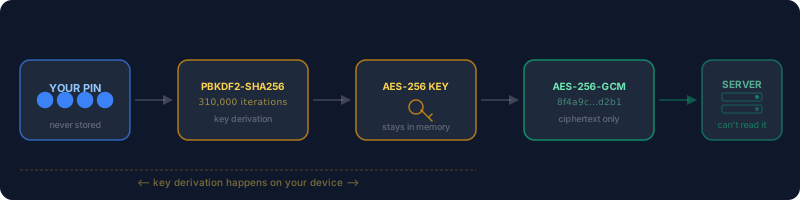
- You enter your PIN. Your device runs PBKDF2-SHA256 (310,000 iterations) to derive an AES-256 key. The key lives in memory only.
- Every workout and nutrition entry is encrypted locally using AES-256-GCM before it's sent anywhere.
- The server receives ciphertext — encrypted bytes with no structure it can read, analyze, or sell.
- When you open the app, the same key derivation runs in reverse. Decryption happens on your device.
The company can't read your data. A data breach at the server exposes nothing readable. The app can't sell what it can't see.
What to look for in a private fitness app
Not all privacy claims are equal. Here's how to evaluate whether a fitness app is genuinely private:
-
On-device encryption before upload — Data is encrypted on your device, not on the server. The company should not have access to your plaintext data.
-
Named encryption algorithm with public specs — Vague claims like "bank-level security" mean nothing. Look for AES-256-GCM, ChaCha20-Poly1305, or another authenticated encryption scheme with a named key derivation function.
-
No third-party analytics SDK — If the app loads Google Analytics, Mixpanel, Amplitude, or similar, your behavioral data is already being collected and sent to third parties, regardless of what the privacy policy says about "your" data.
-
Clear data deletion — You should be able to delete your account and all associated data, and the company should be able to confirm deletion is complete (which is only possible if they don't retain decrypted copies).
-
Red flag: "We may share data with partners" — This language in a privacy policy is almost always a data-selling disclosure dressed in softer language. "Partners" means buyers.
-
Red flag: "Anonymized" or "aggregated" data — Research has repeatedly shown that anonymized health data can be de-anonymized when combined with other data sources. This framing is used to justify sharing data while providing the appearance of privacy protection.
The bottom line
The fitness app industry has a structural data problem. Most apps can only survive financially by treating user data as a product. This isn't a criticism of the people building them — it's a consequence of building on a free-tier, advertising-funded business model in a market where users expect $0 price points.
The solution isn't better privacy policies. It's different architecture. When data is encrypted on your device before it reaches the server — with a key the company never has — there's nothing to sell, nothing to breach, and nothing to hand over under legal pressure.
That's the only model that makes "we can't read your data" something technically true rather than a marketing claim.
Track your fitness without the data harvest.
Hercule uses AES-256-GCM encryption. Your data is encrypted on your device before it reaches our servers. We literally cannot read it.
Open Hercule — Free